Wednesday, October 21, 2009

Ladybugs


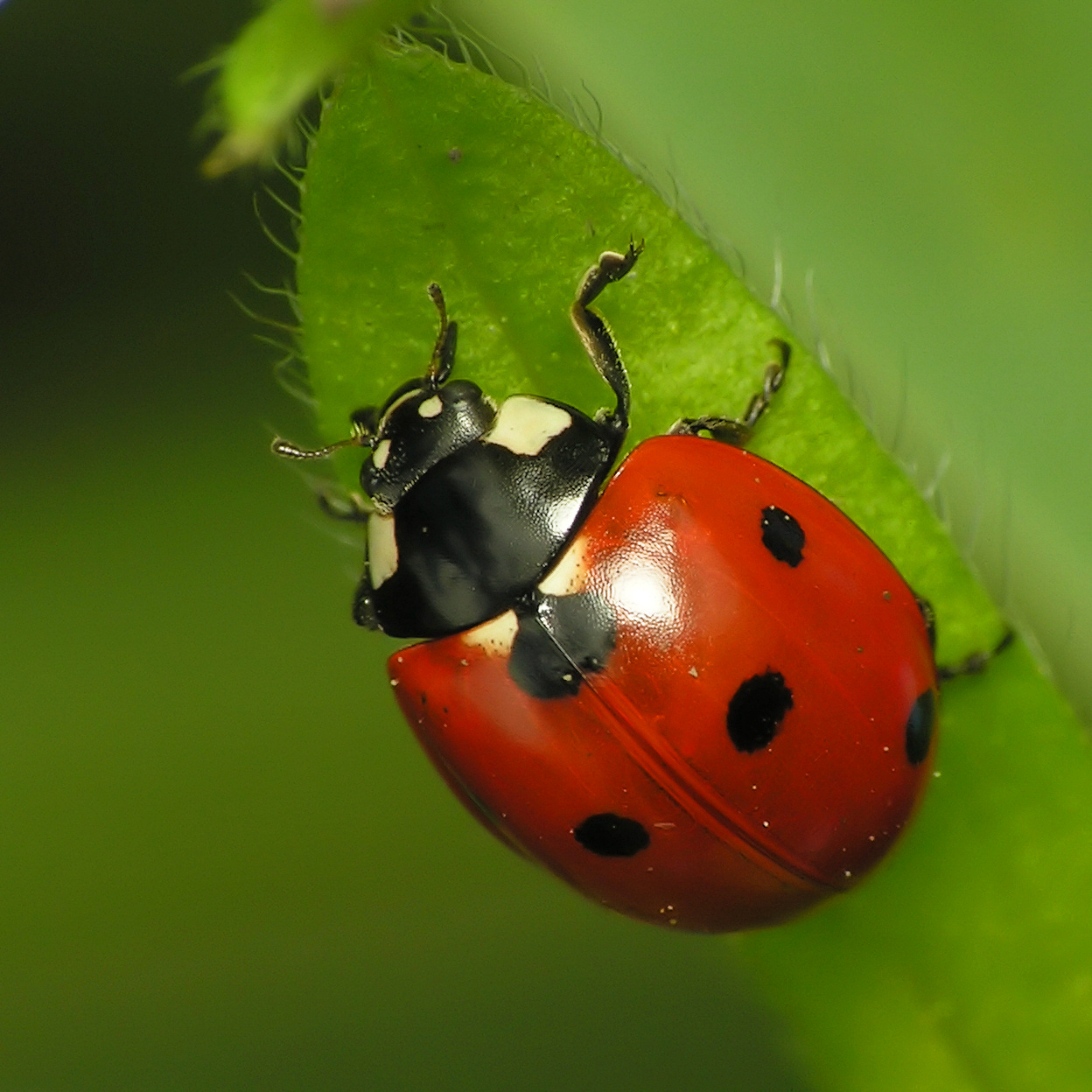
It is that time of year when the ladybugs make their grand debut before the cold weather sets in. It is my favorite time of the autumn season. They seem to only be around for a short time before it gets too cold for them to be flying about, but when they are...it is pretty neat...to me anyway.

Walking around on tiny short legs with little antennas, these tiny round red/orange/yellow beetles have black spots which vary in patterns. These colors and spots make predators unattracted to them. If they are threatened the ladybug can secrete a fluid from joints in their legs which gives them a foul taste and they can play dead!

The Coccinella septempunctata is the scientific name for the ladybug. It can live two to three years in the wild (who would have thought!) I didn't know an insect could live that long!

There are over 5,000 species of ladybugs. In Europe they are called ladybird beetles.

Some of these brightly colored creatures have a great appetite which farmers love because they eat plant eating insects which eat crops. Ladybugs lay hundreds of eggs in colonies of these plant eating insects and when the larvae hatch...they feed on them. These larvae can eat up to 5,000 insects in its larvae stage of life, which is 3-6 weeks. Not all ladybugs eat plant eating insects, some eat plants.

They are also considered good luck in some cultures!

Thursday, October 8, 2009

What are Eye Boogers?

I have always wondered what exactly was going on in the corners of my eyes in the morning. I really hate when I clean them out and this string of goop comes with it. What is this and why does it happen?

Turns out the proper name for eye booger is Rheum. It is a thin mucus that is naturally discharged from the eyes when we sleep. You get "crusties" when it dries. This stuff is made up of mucus discharged from the cornea or conjunctiva from the eye, tears, skin cells, and dust. Rheum can also be seen in the nose and mouth after sleep.

This is produced all the time, but is washed away naturally with tears when you blink. This can't happen when you are sleeping because you are not blinking, so that is why you get crusty eye boogers when you wake up!
The process is not useless, it traps dirt, dust, eyelashes, etc...and coats them in this mucus so it won't scratch your eye...what a great thing to have!

Producing eye boogers is very natural, it happens even in healthy people and children. However, if one morning you wake up and there is a large amount of eye boogers or pus, you could have a serious eye infection.
Sorry to ruin the fun of anyone who thought the sandman came at night but...that is science for you!

Saturday, October 3, 2009

Stephen Hawking Article Grading

This article was an interesting piece on Stephen Hawking; however, after three or four pages, it all blended together and lost my interest. I understand it is about him making a comeback after a few years, but I would have been more interested in the fact that he has survived ALS for so long.

Have there been studies done about him and is he helping contribute to this cause to help others? I haven't found anything...but if he has lived for over 40 years with this disease and hasn't contributed to finding a cure, I have no respect for the man.

I honestly think we should worry about problems here on earth before we go make predictions of things that we can't even get to in space.

Grading:

1. Lede - It was interesting and got me reading it, I think if it had started with "On a mild March evening..." it would have been better. 18/20

2. Content - I think he answered all the right questions. Again, I would have been more interested in the ALS part of his life...but if it wasn't a big part of his life there is no need to talk about it. After the first three or four pages, I became uninterested. I am not big on the study of space, so once they started talking about it I zoned out. 16/20

3. Organization - I really liked the way it was organized with the subheads transitioning from one subject to another. It was very easy to follow. 19/20

4. Quality of Writing - I liked the writing style. It wasn't full of jargon and it was easy to read. Some things I didn't understand sometimes. The author was very good at the disciptions of things throughout the story whish made it interesting at times. 18/20

5. Clarity of Exposition - The author did well in descriptions but lost me because I didn't have any interest, this could pose a problem in some cases. I understand that Discover is a science magazine, but I probably wouldn't read this article by choice and it doesn't help that I really don't know what they are talking about most of the time. 15/20

Tuesday, September 29, 2009

Why does the knuckleball dance?

Imagine…you are up to the plate facing the famous Tim Wakefield from the Boston Red Sox. He winds up and throws. You watch the ball leave his hand, but as it comes near you…it doesn’t seem to be spinning…or following the path you expect. You swing... "STRIKE!" That pitch you just missed was called a knuckleball.

The knuckleball is one of the hardest pitches to hit, catch, and throw in the game of baseball. If you have ever played and faced a knuckleballer, you will know that the ball tends to dance and move as it is coming toward you. You probably will not know where it will be when it gets to you…earning yourself a strikeout or a walk.

This pitch is designed to minimize the spin of the ball when it is thrown. This lack of spin causes the ball to change paths and move in the air. If thrown correctly, it can dip, dive, and sometimes vibrate in flight, tricking the hitter. The dancing that the ball does refers to the stitching of the ball randomly changing orientation.

It also has a very slow spin, aiming to have about one and a half to two rotations from the pitcher's release to the catch. The spin is caused by the Magnus effect. This is where the air mass is deflected in one direction and the ball mass is deflected in the other direction. With the knuckleball, the center of mass of the ball is constantly changing direction, and with it the air mass must change too.

With this movement, the seams (stitches) slowly move and cause the air to separate from the ball. The orientations of the seams cause the air to push the ball causing it to go in different directions giving the illusion of dancing.

"Knuckleball" comes from the original grip of the ball; the knuckles gripped the ball instead of the fingers and then pushed with the release. This technique has been altered over time to the pitcher digging the fingernails of the middle and pointer fingers into the ball, with the thumb and pinkie as a support, but still pushing the ball with the release.

When thrown, every pitch can have control problems; however, the knuckleball is one that can be the most difficult to master. If a pitcher can learn how to throw it, it can be a very dangerous weapon in the pitching game. So watch out when you face one…you may win, but you also may lose…especially if you face a guy like Wakefield...don’t worry, he is been on the DL most of this season.

Friday, September 25, 2009

Hasn't Anyone Told You Mr. Bumblebee?


Apparently, nobody has ever told the darn bumblebee that it can't fly. According to scientists, bumblebees are 'aerodynamically incompatible with flight'. The main question is...why doesn't the bumblebee listen?

This conclusion was based on calculations using the aerodynamic theory of 1918-19. This theory basically said that bumblebee wings were too small to create sufficient lift to support it. There are many different "myths" about who discovered that the bumblebee shouldn't be able to fly.

A study done in early 2009 at Oxford University, found that the bumblebee's wings work independently from one another. This showed that it the airflow around the wings never joins up to support the insect, but yet...it still flies.

They say this is "the power of its own ignorance" that it doesn't know it can't fly. Really...who cares if they technically can't fly...isn't that what is great about nature? Somethings should be left unanswered.

Lede of the Week

The title is what caught my eye for this one: The New Weapon Against Climate Change: Condoms and I am sure I have gotten your attention now!

"Forget, for a moment, all those fancy geoengineering schemes that would alter the face of the planet in an attempt to reduce global warming’s impact. Population scientists argue that a cheaper and simpler strategy is to hand out birth control to those who want it–especially to people in the developing world, where birth rates are booming."

This is a lede that makes me want to finish the article, which I did and found an interesting theory. Why is birth control the answer to global warming? As the article goes on to explain...less people=smaller carbon footprints. So protect our planet by protecting yourself!

Sunday, September 20, 2009

Holy Burning Bush!

Days are getting shorter and the weather is getting cooler. There is at least one thing to look forward to, the brilliant colors of the trees around us in the Adirondacks. However, there is a plant that may take the show from the rest.

The Burning Bush gets its name from the fiery colors its leaves turn in the autumn which can be amusing to the human eye. The Burning Bush is also known as the Winged Euonymus because of the corky ridges that protrude from its branches. The scientific name is Euonymus alata; Euonymus meaning spindles and alata meaning winged in Latin. Some think it gets its name from the Bible, when Moses comes across a burning bush in the desert, but most likely it is because of the spectacular show it puts on in the autumn.

This plant produces a purple fruit that grows in clusters and split open when they are ripe revealing bright red insides that adds to the burning effect.

Some species of this plant can grow to over 15 feet high, with dwarf species growing slightly smaller.

It is originally from Asia, giving it an invasive status here. They were brought over to North America in the mid-1800s as oriental decorative plants.

The Burning Bush can be a problem for native species of plants, because they take over large thickets of natural forest. The original plant can produce many unwanted seedlings; because of those unwanted seedlings, there have been mass over takings in the eastern United States of these plants. Once their root system is in place, it can be very hard for other plants to grow.

Many people enjoy having these plants in their yards because of the brilliant colors they produce in the autumn. They are very easy to take care of, but they can overtake an open space if they are not monitored properly. They lose their leaves in the winter like many trees and shrubs in the Northeast, but they come back in the spring to get ready for their autumn show all over again.